As Weather Volume 3: Budawang Mountains – Release date 19th April 2024 (Splitrec 33) LP, CD, DL
Jim Denley (gum-nut and flute) and the eternally orchestrating sonoverse
Now available for preorder is the third volume of Jim Denley’s as-weather musicking. This is the final part of the trilogy, In/With/As Weather Volumes 1-3 (splitrec 31, 32, and 33). This project has emerged over the last four years musicking/recording with Budawang Mountains (Yuin Country) and Sydney Harbour (Gadigal Country). Splitrec believe this is a significant new addition to improvised music, ecological art, and to Country.
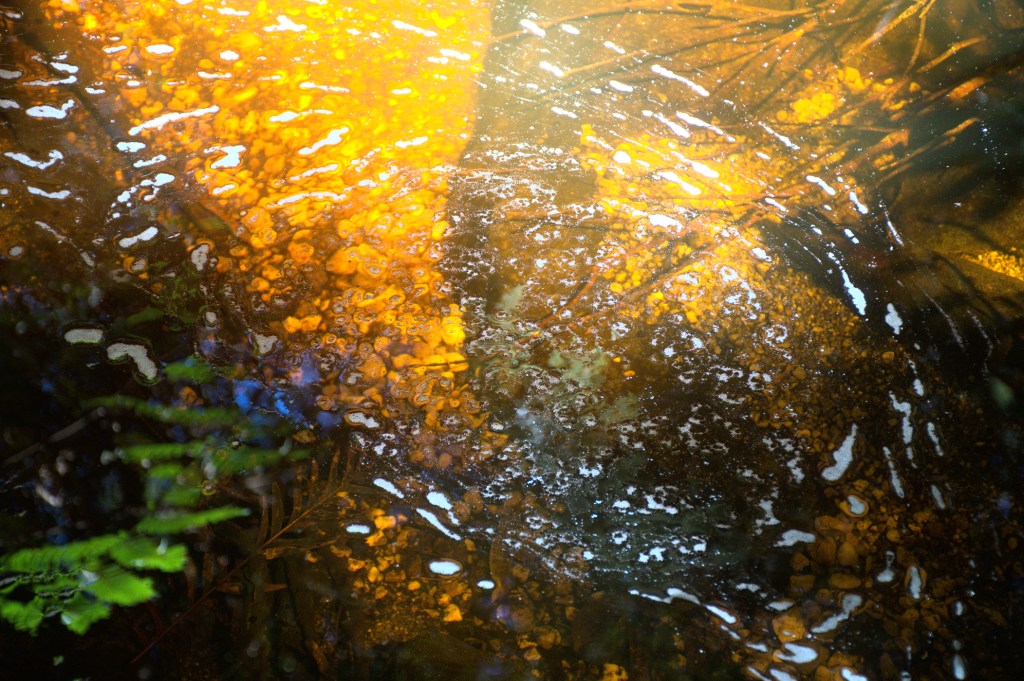
The cover photo was taken looking down at the Creek that cuts Ravine, which runs through the Monolith Valley, Budawang Mountains of the Yuin Nation – where As Weather volume 3 was recorded. Jim writes in the liner notes; “On a meteorologically calm day, such as the day Diffraction Study 1 (side G) was recorded, Avian, Arboreal, Amphibian, and Insect musickin quietly saturate, forming this place. Forming this place too, Human poetics and musics have played over deep time. Water running off Budawang Bura is tinged orange by dissolved minerals; midday Sunlight cuts through Ravine’s rich green Rainforest with its mottled pinkish-grey Coachwood Trunks and fleshy Tendrils searching for Sunlight; Rays illuminate Creek’s bottom and refract shards of Sky and Foliage; a stratum of white slow-spiralling Foam surfaces the Water. Sounds likewise spiral the quietness, diffracting with Ravine’s cooler damp Air, stone Walls, sandy Floor, Caves, Leaves, Trunks… Their transparent acousticking demands reciprocity; it’s joyful to join; musicking, one can offer greetings and entwine with Ravine’s spirits. Places such as this are why I music.”
With Weather Volume 2: Gadigal Country – Release date 8th Sept 2023 Splitrec 32
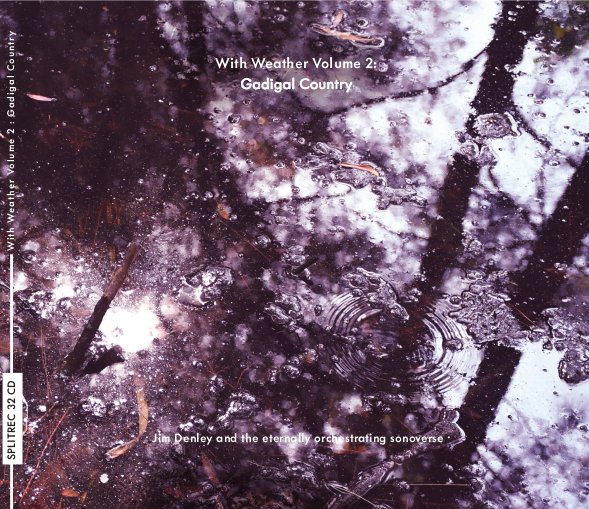
Volume 2 of Jim Denley’s with-weather series, available on LP, CD and DL.
Jim Denley – flute, gumnut, voice with avian, mammalian, arboreal, amphibian, industrial, and elemental musickin.
Recorded 2021/22 on Gadigal Country of the Eora Nation around the harbour east of the City of Sydney. This Country was never ceded, and this music is a way of paying respects to elders past, present and emerging, and the amazing soundscapes of this Country.
“a 100+ minutes lasting take on GeoMusic and deeply spiritual, 100% acoustic EcoAmbient especially valuable for fans and followers of Deep Listening Music in its purest form, featuring bird chatter and barking dogs as well as droning, oftentimes slightly off-kilter flute sequences, ominous low frequency rumbles of unclear origin, mechanical air flows and hypnotic, ever repeating fragments of melodies, static crackles and everlasting eternal calmness, rural water flows, colliding sticks, rocks and partially indecipherable voices deeply embedded in the mix – an amalgamation which is probably the closest a modern day listener can come to what could be described as a recreation of ‘early ancient music’ experienced by our ancestors thousands or more years ago. This is a time-dissolving trip.” BAZE. DJUNKIII writing in Nitestylez.
In Weather Volume 1: The Hidden Valley
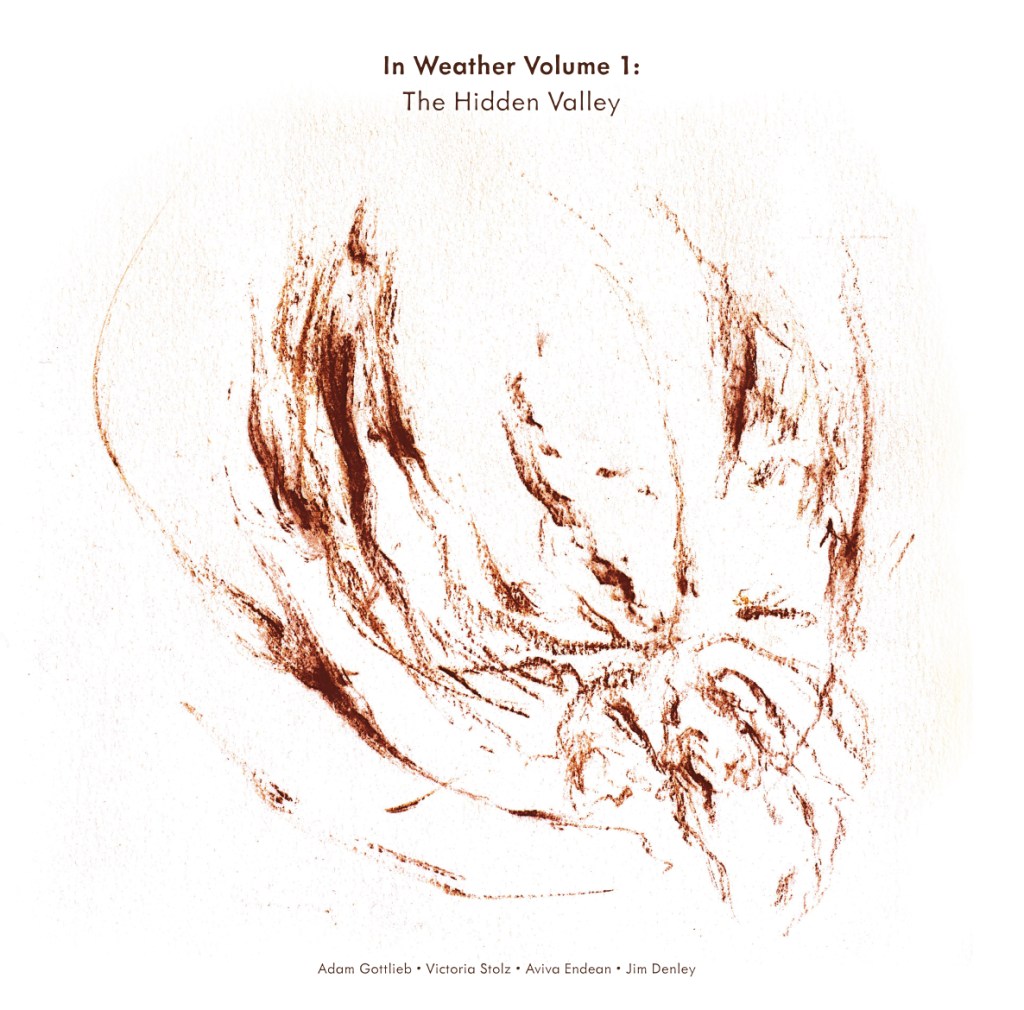
Splitrec 31, available on LP, CD and DL. Available on Bandcamp.
Adam Gottlieb – stones and trees. Victoria Stolz – charcoal drawings. Aviva Endean – clarinets, plastic tubes, pocket amplifier and stones. Jim Denley – flute, gumnut, vocals and stones
Since the late 1980s Jim Denley has been musicking with the Hidden Valley, Budawang Mountains, regularly hanging out there to play/record. This volume, (the first of three), presents audio recordings and drawings co-created over a few wonderful days there, with a band of human artists, critters, stones, trees and energies.
Musicking and musickin (to use Hannah Reardon Smith’s term) are inherently and eternally part of the Hidden Valley, and all musicians, human or non-human, delight in their special listenings/soundings. Weather is ever-changing meteorological flux, which intra-acts with and co-sculpts Budawang rock. Improvisation is kin to this flux — our most context-responsive, sympoietic method of musicking — it too has the power to be part of shaping and transforming. Improvising our listening/sounding in weather we can be relational-to, attuned-to, playful-with, and deeply entangled-in Country. With ecologically attuned listening/sounding skills, we can open to the eternal orchestra of the sonoverse, and express not just human intentions, but allow our soaring voices, as Michel Serres writes, to; “…come from the earth, through the intermediary of the volcano-body. The soul is a life-sized wind instrument.” With modern portable recording equipment we are gifted these audio phenomena sourced from these playful improvisations, our Gaia songs, this geo-music. The voice of Budawang stone is ancient beyond our knowing, singing an old and novel song.
Recorded in the Hidden Valley, Budawang Mountains, Yuin Nation, between November 22-24, 2021. The Hidden Valley is unceded Aboriginal land. We would like to acknowledge the Traditional Custodians, the Yuin people, on whose land these recordings are made. We pay respects to elders past, present and future.
“…a classic example of improvisational ecology built on respect for the land and those who protect it… The genuine pleasure this writer experienced while deepening his knowledge of the quartet is equal to his ignorance of the geopolitical implications of the location in question. But none of this diminishes the enjoyment of the album. The performers appear wholly absorbed in the local environment, surrounded by organic, animal, and just faintly “modern” sounds… as they play – or beat – various types of wind instruments, objects, stones, trees… One must be open to noticing minutiae that, more than those of a musical statement, relate to priceless slivers of existence.” Massimo Ricci writing in Touching Extremes
Splitrec 30 Release Date: September 16 2022.
back, before Great Waitress

Magda Mayas (piano), Monica Brooks (accordion), Laura Altman (clarinet and feedback).
Formed in 2009, the members live on two separate continents but have maintained the relationship through concerts, touring and recordings. Their first release Lucid (Splitrec CD 22) was recorded in 2011 and released in 2013. John Shand wrote: “If spiders have musical dreams while spinning webs, they might sound like the fragile wisps of sound created by Great Waitress.” Their second, Flock (234 CD Creative sources) was recorded in 2013, released in 2014, Shand wrote again about dreams; “…the resultant music evolves like the soundtrack for a dream that is both enticing and disquieting.” Their third release Hue (Another Dark Age LP Aoo6) was recorded in 2014, released in 2016. Bob Baker Fish in Cyclic Defrost wrote; “…really quite remarkable. It squeaks, rattles reverberates, shimmers, converges into a truly unique organism, one that feels not just far beyond the sum of its parts, but also, oddly enough quite untouched by human hands.” This fourth release, recorded before the pandemic and lockdowns in 2018, has taken four years to get to production. A live set, back, before was beautifully recorded by Peter Farrar at the Annandale Creative Arts Centre, mixed and mastered by Joe Talia.
In the elegant liner notes, Chris Abrahams writes of Great Waitress transcending “…the individual contributions of Mayas, Altman and Brooks. It’s an identity made from a multi-dimensional counterpoint – timbral, rhythmic, harmonic, melodic, emotional… – that results in an ever-evolving gestalt.” He finishes with: “External sound phenomena are subsumed by a music that welcomes any wayward noise, clothing it instantly in its mystery and beauty. The musicians can’t put a foot wrong, because the whole concept of ‘wrong feet’ is anathema to their ideology.”
Great Waitress unfold soundscapes, and beyond their horizons there is nothing to be heard but other soundscapes, and still other horizons. But if we go the other way — forensically listen in to the minutiae — there is nothing inside the sounds but other smaller sounds. They do this inward/outward listening within each of their four amazing releases and they also do it across these releases. This listening is achieved because we never arrive at cliché, genre, or the entirely known or predictable — Great Waitress keep you suspended on a cusp between knowability and novelty.
They have unfolded a body of work, of which back, before is the latest stunning example, that speaks of a brilliant, patient, humble collectivity — one of the most important improvising ensembles of the last decade. We hope you discover Great Waitress’s world.
“The reverberant performance space makes the air thick and heavy and quiet, sporadic sounds in clusters and clouds ripple through for tensive atmospheres. The accordion is a kind of bridge to keyboard and wind and this spectrum of instrumental material manifests in their breadth of approaches. Piano can sound more lamellophone than a harp’s rich decay, accordion rattles and crumples, and clarinet chirps in tropical warbles for discrete movements but can chime, sigh, and breathe in sustain together for beating harmonic interactions. Texture becomes tethered to rhythm and melody and harmony begin to feel the same at different scales. At every level limen dissolve and their haze creates a sense of dream states.” Keith Prosk, Free Jazz Blog.
 s p l i t r e c